
Spuyten Duyvil 2026
At once historical novel, erudite inquiry, and intimate character study, Elisabeth Sheffield’s Sex and Character boldly examines how medicine, culture, and language shape our understanding of the body, and how the body continually resists the limits imposed upon it.
New York City, 2020. Stefan Pröscholdt Krause, an eighty-year-old retired medical librarian, is isolated in quarantine, dying of breast cancer, when an unexpected chromosomal analysis forces him to confront a truth about his own intersex body that has remained hidden for decades. As his diagnosis unravels the certainties of a lifetime, Krause is drawn back to seven pivotal months in 1966, when, as a young German researcher newly arrived in America, he worked in a pioneering genetics laboratory and became entangled with his brilliant mentor, Dr. Jack Seurat, a celebrated geneticist harboring a secret that would alter both their lives.
In the present, Stefan’s solitary existence is disrupted by Raven, a twenty-four-year-old Icelandic graduate student whose connection to Stefan reaches further into the past than either could imagine. Together, their lives expose the unexpected legacies of desire, kinship, ambition, and the uneasy categories through which we understand sex, identity, and inheritance.
Moving between the dawn of modern human genetics and the uncertainties of the COVID era, Sex and Character explores a moment when advances in chromosomal science collided with the sexual revolutions of the 1960s, raising urgent questions that continue to reverberate today.
With the intellectual ambition and formal inventiveness that define Elisabeth Sheffield’s work, Sex and Character probes the unstable boundaries between language and reality, the body and identity, and the ways narrative, science, and culture shape our understanding of sex, desire, memory, and identity. In conversation with Paul Preciado’s Testo Junkie, Cristina Rivera Garza’s The Iliac Crest, and mid-century taboo lesbian novels like Valerie Taylor’s The Girls in 3-B, Sheffield's brilliant, audacious novel asks what happens when the stories we inherit about the body can no longer contain the lives we live.
-John Madera, author of Nervosities (Anti-Oedipus)
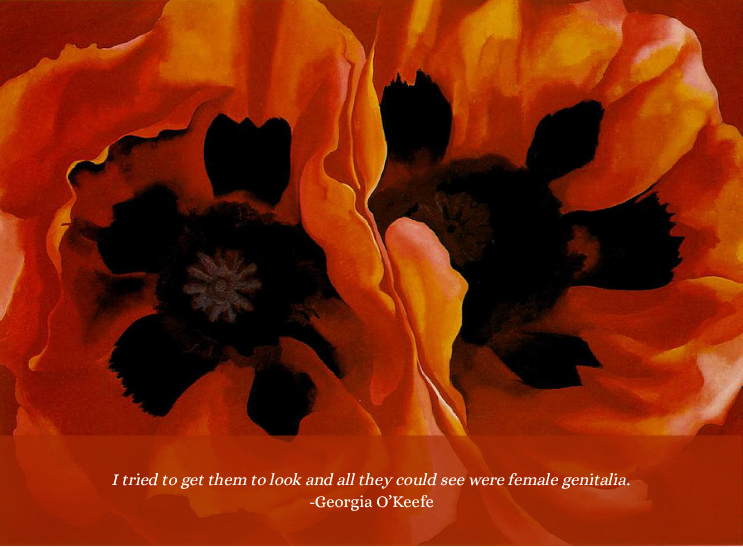

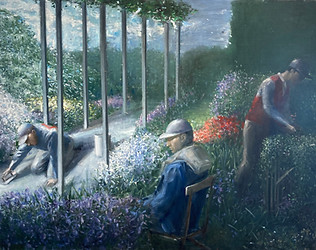


Painting by Raymond Han
Painting, minus O’Keefe insert, by Karl Kipfmueller
“Elisabeth Sheffield’s Sex and Character is a bold, erudite, darkly comedic novel that fuses scientific discourse with erotic obsession and narrative instability. Oscillating between memory, experiment, and hallucination, Sheffield dismantles the boundaries between body and theory, fact and fabrication. This is fiction as intellectual contagion—precise, unsettling, and impossible to shake.”
—D. Harlan Wilson, author of Outré, Usurper, Dr. Identity, and many other books
"Elisabeth Sheffield has written the anti-Bildungsroman we need urgently today. Instead of asking how a person becomes themselves, Sheffield asks whether there was ever a stable self there to become. Embryology is deployed as a poetics, as bodies, memories, desires, and identities differentiate, duplicate, mutate, and graft themselves onto other histories. In a world where memory has its own observer effect, the closer her protagonist looks, the less singular the self becomes. Ironically, the closer we read Sheffield’s brave and beautiful book (and it demands close reading), the more singular we realise it is. Wickedly intelligent, formally thrilling, deliciously corporeal, funny, and disturbing, Sex and Character dismantles the comforting distinction between the normal and the monstrous, asking instead who gets to make that distinction, and what violence begins with the act of looking."
—Stacy Hardy, author of Because the Night and An Archaeology of Holes